
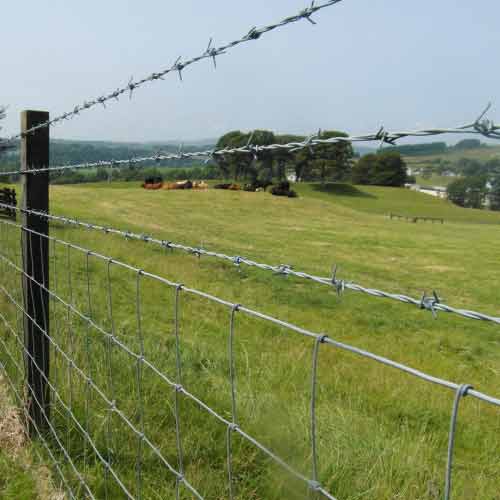
There is no absolute physical maximum length for a barbed wire fence installed at one time; the limiting factor is the mechanical capacity of the fencing equipment and the electrical power available to maintain proper wire tension. Barbed wire is sold in heavy rolls, typically containing over 1,300 feet of wire, which can be unspooled and attached to posts for miles. However, as the distance increases, the physical friction on the wire and the resistance required to stretch it taut become immense, requiring specialized machinery and careful planning.
Understanding the Role of Wire Tensioning Equipment
The true limit to installing a long stretch of barbed wire is the fence stretcher or spooler. Manual fence stretchers require human labor to pull the wire tight, making them impractical for runs much longer than a few hundred feet. For installations stretching thousands of feet, tractor-mounted hydraulic unspoolers and mechanical stretchers are mandatory to pull the heavy gauge wire to the required tension without snapping it.
Managing Voltage Drop in Electrified Barbed Wire
If the barbed wire fence is going to be electrified, the maximum length is severely restricted by the capabilities of the energizer. Electricity loses power as it travels down a wire. For a single strand of barbed wire, voltage drop becomes a significant issue after 1,000 to 2,000 feet. To install miles of electrified barbed wire, you must use a high-output energizer and install multiple parallel "hot" wires to carry the current efficiently.
Preventing Wire Sag Over Long Distances
Gravity and wind take a heavy toll on barbed wire over long distances. Even with perfect tension, a single strand of barbed wire will sag between posts if the distance between corner posts is too great. To install extremely long fences, the line must be broken up with intermediate brace assemblies every quarter-mile or so to maintain structural integrity and prevent the wire from drooping to the ground.
Utilizing Heavy-Duty Corner and End Post Assemblies
The longer the fence line, the greater the cumulative pulling force exerted on the corner and end posts. A fence stretching for miles will generate thousands of pounds of tension. The corner posts must be massive, set deeply in concrete, and supported by heavy diagonal brace beams to prevent the wire from pulling the entire corner assembly out of the ground during installation and winter contraction.
Navigating Terrain Changes and Friction
When installing miles of barbed wire across uneven terrain, the wire will rub against intermediate posts, rocks, and vegetation. This friction makes it incredibly difficult to pull the wire tight from one end of the fence to the other. Professional installers often pull and tension the wire in smaller sections—such as a quarter-mile at a time—rather than attempting to stretch the entire length of the property in one continuous pull.
Coordinating Roll Splicing for Continuous Lengths
Because barbed wire rolls are finite (usually around 1,320 feet), creating a continuous fence of several miles requires splicing the rolls together. While knots can be used, mechanical wire splices or crimping sleeves are preferred for long fences to maintain the full tensile strength of the wire. Managing these splices and ensuring they do not catch on the spooling equipment adds logistical complexity to ultra-long installations.
Planning a massive agricultural fencing project? Contact our rural fencing experts to ensure your barbed wire installation is engineered for success!
FAQs
Q: How long is a standard roll of barbed wire?
A: A standard commercial roll of barbed wire contains approximately 1,320 feet (400 meters) of wire, weighing roughly 80 to 100 pounds depending on the gauge.
Q: Can I install a barbed wire fence by myself for a long distance?
A: It is highly discouraged. Unspooling and tensioning heavy barbed wire over long distances requires at least two people, and ideally a tractor with a hydraulic spooler to prevent kinks and injuries.
Q: How tight should a long barbed wire fence be?
A: It should be tight enough that you cannot easily push the wires together with your hand, but not so tight that the strain damages the corner posts. A slight give is necessary to prevent the wire from snapping in cold weather.
Q: What happens if I try to pull too many feet of wire at once?
A: The friction against the posts will become too great, and the wire will either jam on the spool, kink permanently, or the extreme tension will cause the wire to snap, which is highly dangerous.
Q: Does adding more strands of barbed wire shorten the maximum distance I can install?
A: No, adding more strands does not change the physical distance you can install. However, each additional strand multiplies the total pulling force on your corner posts, requiring heavier bracing.
-
2026-05-03For enclosing large areas quickly or establishing temporary perimeters, the Fence Roll offers a convenient alternative to panel-by-panel fencing. Made from interwoven wire or mesh mounted on a flexible backing, it can be unrolled along the ground and affixed to posts or stakes to form a co
-
2026-05-02A long barbed wire fence should be tensioned to a "firm" state, often described as having the tension of a bass guitar string, rather than being pulled "guitar-tight." Over-tightening is a common error that can lead to wire breakage, especially during temperature drops
-
2026-04-30Wire fence serves as a broad category of affordable, practical barriers used to define space, provide security, and contain animals. Its fundamental principle involves using strands or grids of metal wire, typically steel, to create a physical limit. This category includes everything from