
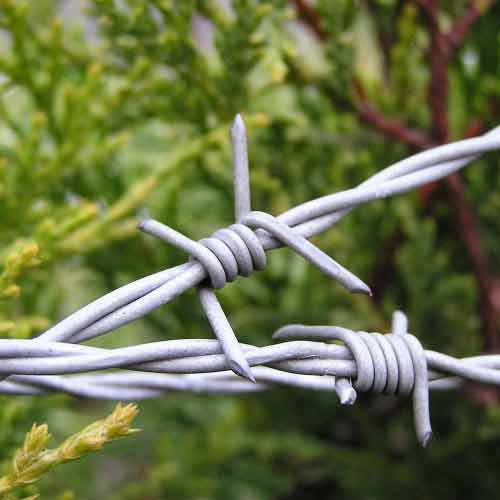
Barbed wire fence consists of high-tensile steel strands with sharp barbs spaced at regular intervals (typically 4–6 inches), designed to inflict pain and deter physical intrusion. Its primary function is perimeter security for agricultural, industrial, and military applications, where cost-effectiveness and psychological deterrence outweigh aesthetic concerns. Unlike razor wire, barbed wire relies on entanglement and injury risk rather than lethal force, making it suitable for livestock containment and low-to-medium security zones.
Construction and Materials
Wire Gauge: 12–14 AWG (2.5–3.0 mm) for strength.
Barb Design: Twisted strands with 2–4 points; spacing prevents animal entrapment.
Coating: Galvanized (zinc-coated) for rust resistance; PVC-coated for visibility.
Tensile Strength: 500–800 MPa to resist cutting and stretching.
Primary Applications
Livestock Control: Prevents cattle/sheep from breaching boundaries.
Perimeter Security: Deters casual intruders in rural/industrial areas.
Temporary Barriers: Used in construction or disaster zones.
Military/Defense: Historical use in trench warfare; modern use in forward operating bases.
Safety and Legal Considerations
Barbed wire must comply with local safety codes—many jurisdictions prohibit its use in residential areas due to injury risks. Warning signs ("DANGER: BARBED WIRE") are mandatory at 50-foot intervals. For public spaces, electric fencing or smooth-wire alternatives are preferred.
Comparison with Razor Wire
Feature Barbed Wire Razor Wire
Lethality Non-lethal (pain-based) Potentially lethal
Cost 30% cheaper Higher due to complexity
Installation Simple (staple to posts) Requires specialized tools
Maintenance Low (rust-resistant) Moderate (blade replacement)
Installation Best Practices
Post Spacing: 8–12 feet for tension maintenance.
Strand Count: 3–5 strands for livestock; 5–7 for security.
Height: 4–5 feet for animals; 6–8 feet for humans.
Ground Clearance: 6 inches to prevent vegetation contact.
Secure your property with industrial-grade barbed wire engineered for maximum deterrence. We supply galvanized and coated options with compliance documentation. Contact us for a security assessment and material quote.
FAQ:
Is barbed wire illegal for homes?
Yes—in most urban areas; check local ordinances.
Can it stop determined intruders?
No—determined individuals can cut it; use with cameras/alarms.
Does it hurt animals?
Yes—use smooth wire for horse pastures.
How long does it last?
20–30 years with galvanization.
Can I electrify it?
Yes—but requires insulators to prevent short circuits.
-
2026-05-03For enclosing large areas quickly or establishing temporary perimeters, the Fence Roll offers a convenient alternative to panel-by-panel fencing. Made from interwoven wire or mesh mounted on a flexible backing, it can be unrolled along the ground and affixed to posts or stakes to form a co
-
2026-05-02A long barbed wire fence should be tensioned to a "firm" state, often described as having the tension of a bass guitar string, rather than being pulled "guitar-tight." Over-tightening is a common error that can lead to wire breakage, especially during temperature drops
-
2026-04-30Wire fence serves as a broad category of affordable, practical barriers used to define space, provide security, and contain animals. Its fundamental principle involves using strands or grids of metal wire, typically steel, to create a physical limit. This category includes everything from